Anomaly, Paradox, Mystery, and the Unexplained
As the accuracy and precision of our observations and experiments have radically improved, it would appear we understand less than we thought.
In this section we explore the application of Expanse Tension Theory (ETT) to gravitatonal, cosmic expansion, acceleration, and velocity anomalies, and discover the density-scalar resolves without invoking dark matter and dark energy constructs. The mathematical infinite singularities at the Big Bang and Black Holes become unnecessary.
We also apply General Expanse Tension Theory (GETT) to the atomic work, and Quantum Mechanics, and discover that the Copenhagen Interpretation of an unknowable, probablistic random universe is removed with the simple presence of an all-pervading scalar field.
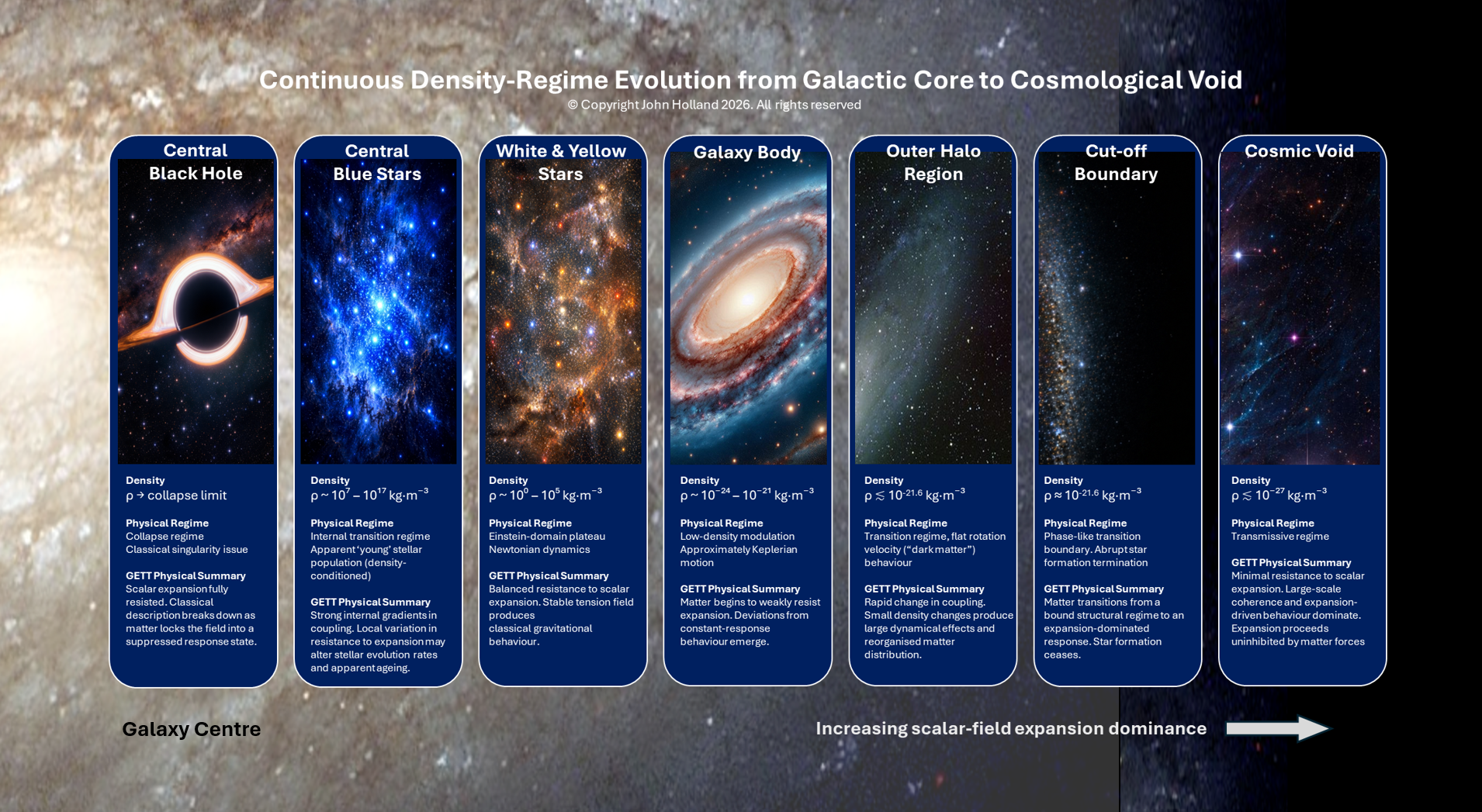
Galactic Dynamics: Regimes from Core to Void.
Galaxies are awe-inspiring, enigmatic, and still deeply misunderstood. Since the discovery that their outer regions rotate too rapidly for
conventional gravity to explain, fundamental questions have persisted about how these vast systems remain bound. The abrupt cut-off in star formation toward their edges adds another layer of mystery, hinting at underlying processes not yet fully understood. At their centres, supermassive black holes present even greater challenges, with behaviours that stretch the limits of current theory. Together, these features reveal galaxies not as solved structures, but as profound cosmic laboratories, pointing toward missing physics in our understanding of the universe.
The graphic above shows that galaxies are not governed by a single rule. In GETT, their behaviour emerges from density-driven transitions from core to void—where outer-region dynamics arise naturally, without the need for ‘dark matter’.
Cosmology & Astrophysics
Resolved:
The Hubble Tension
The Hubble Tension
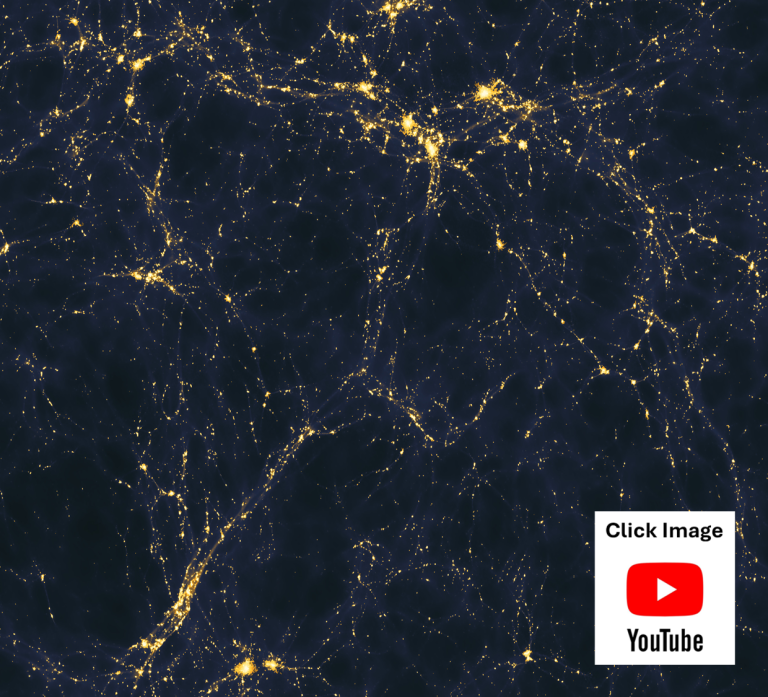
ETT compresses nine independent probes of the Hubble constant into a narrow corridor of 70.3–70.6 km s⁻¹ Mpc⁻¹, centred on a mean of 70.49 km s⁻¹ Mpc⁻¹, with residual dispersion below 0.5%.
Resolved:
Dark Energy
Late Time Acceleration (LTA):
"Dark energy" does not exist
This work establishes ETT as a physically motivated alternative to ΛCDM, offering a causal, mechanistic explanation for late-time acceleration grounded in quantum field field first principles.
Resolved:
Dark Matter
Galaxy Flat Rotation Velocity:
"Dark matter" does not exist
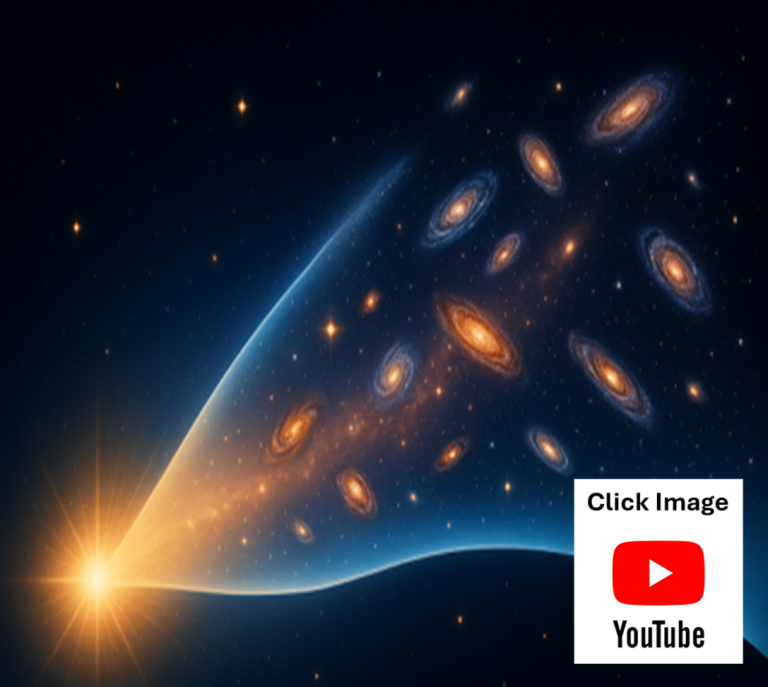
The observations are correct, the hypothesis of "dark matter" is wrong. Every single observed "dark matter" singatrure exists beyond a low-density threshold, or from photons passing through the extreme low density void. GETT scalar field to Higgs portal mechanism holds the key to the answer.
Resolved:
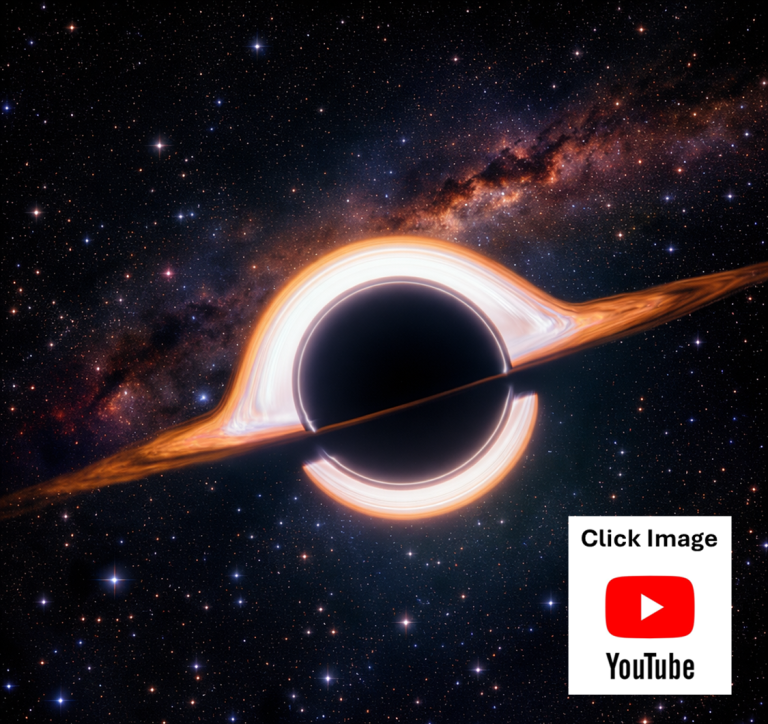
Singularity
The De-emergence of Mass with Symmetry Restoration
Electroweak Symmetry Breaking (EWSB) of the Higgs portal has been proved by CERN to be the quantum firld trigger for mass. So, out that in reverse: in ultra-high-dense environments (Big Bang & Black Hole cores), symmetry restoration de-emerges mass, and therefore gravity, inertia, and time cease: No Singularity!
The Atomic and Quantum World
Resolved:
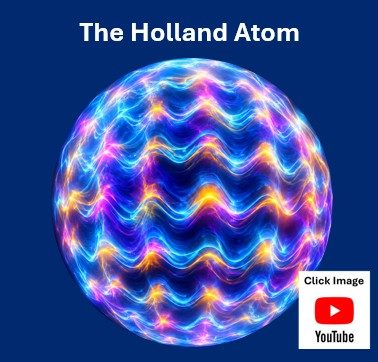
The Holland Atom
Add a density dependent scalar field and resolve the Atom...
The reconstruction programme successfully reproduced shell
capacity structure, angular resonance-family structure, shell-
opening order, sequential shell filling, radius contraction
behaviour, lanthanide and actinide compression, and historically anomalous transition-metal configurations without anomaly-specific correction rules or post-calibration structural modification.
Resolved:
Double-Slit
Experiment
Paradox
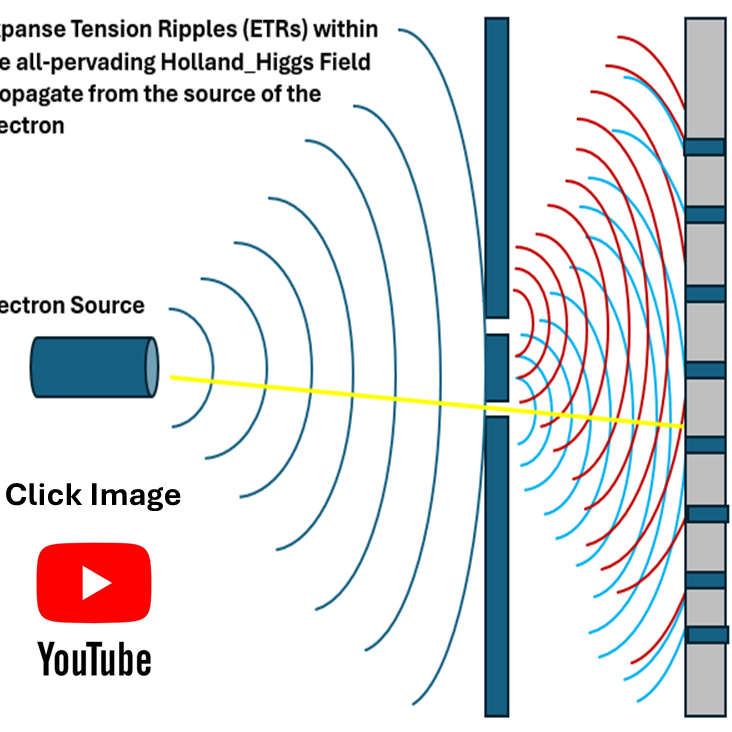
Thomas Young's Double-Slit Experiment Paradox Resolved
224-years ago Thomas Young shone light at two slits and saw something that changed the world. Over a hundred years later, Taylor fired a single particle at a time, and witnessed the same
statistical interference pattern. Quantum Mechanics interpretation went wild. Now, see what happens when you add a QFT-permitted GETT scalar field to the universe...
Resolved:
Glass Reflection Paradox
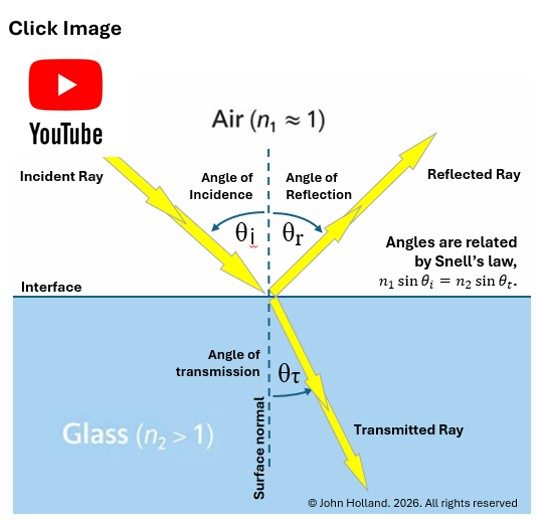
The 1986 Richard Feynman Glass Reflection Paradox
Photons of light reflecting off a glass surface appear to possess prior knowledge of the deeper background bulk material. GETT
introduces material density dependent tension gradients in the all-pervading scalar field, which justify and explain the observed change in reflected intensity with changes in rear bulk material.
Resolved:
Water Paradox
The 44-Paradoxes of Water
Please take my word for it: Water is a real freak of nature. With 44 paradoxes and anomalies which make this the most bizarre and unexplained substance in the universe, defying the normal basic
established rules of physics. But what if water is just the perfect antenne for a density dependent scalr field? What if these
anomalies are simply the ultra-high "expressivity" of water's
reaction and response to the GETT Holland field?

Resolved:
CERN Pb-Pb
Collision Anomalies
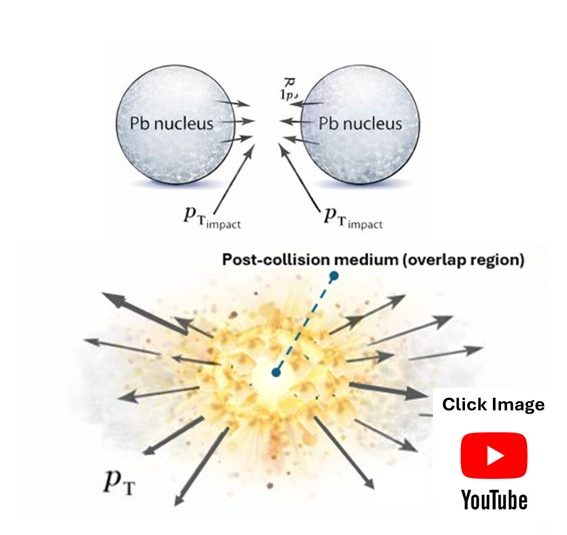
CERN ALICE & ATLAS Pb-Pb "Outward Radial Flow" anomalies
ALICE and ATLAS collaborations at CERN have revealed long-range transverse-momentum correlations in ultra-relativistic Pb–Pb
collisions. The observed patterns show that the particles’ outward motion is not simply inherited from the collision but is actively
reorganised by the medium formed after impact. The physical
origin of this isotropic, density-sensitive expansion response
remains causally under-specified. We show that these are structurally aligned with the class of effects predicted by a density-dependent expansion modulation.
Foundational Physics
Resolved:
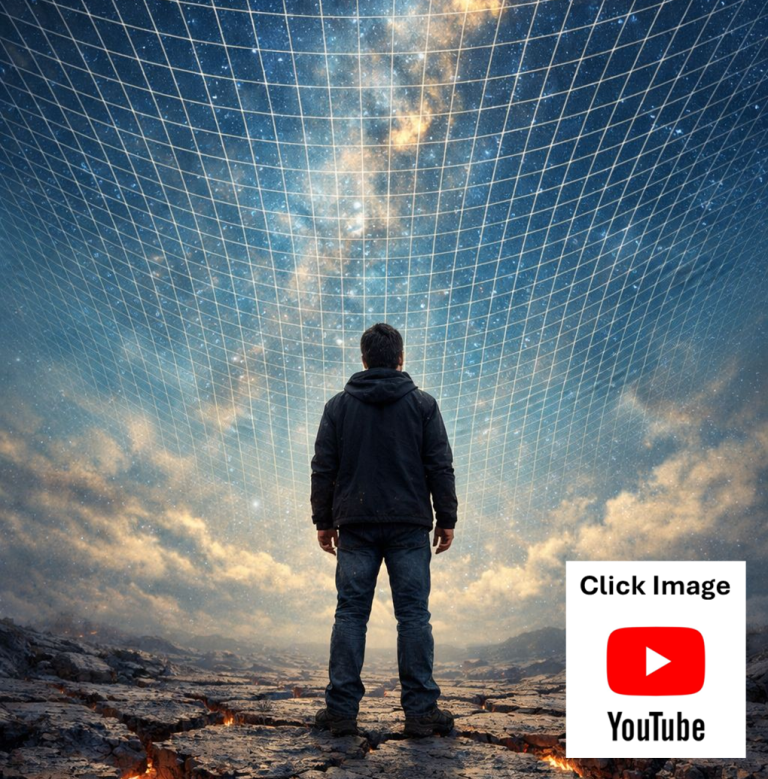
Gravity's Cause
Back to being a force again! The equilibrium restoring force
In GETT, gravity is not fundamental geometry but a real restoring force arising from gradients in the scalar field Φ. Geometry,
calculus, and geodesics remain accurate mathematical
descriptions of the resulting motion, but the underlying cause is physical tension imbalance, not geometry itself.
Resolved:
Inertia's
Cause
Motion without friction requires energy...now we know why...
Why is the equation to calculate the amount of energy required to move mass a distance at a speed equaly to half mass times
velocity-squared? Why this precise ratio? In GETT kinetic energy represents the energy required to reconfigure the scalar field Φ as mass moves through it, reflecting resistance to that reconfiguration.
Resolved:
What actually
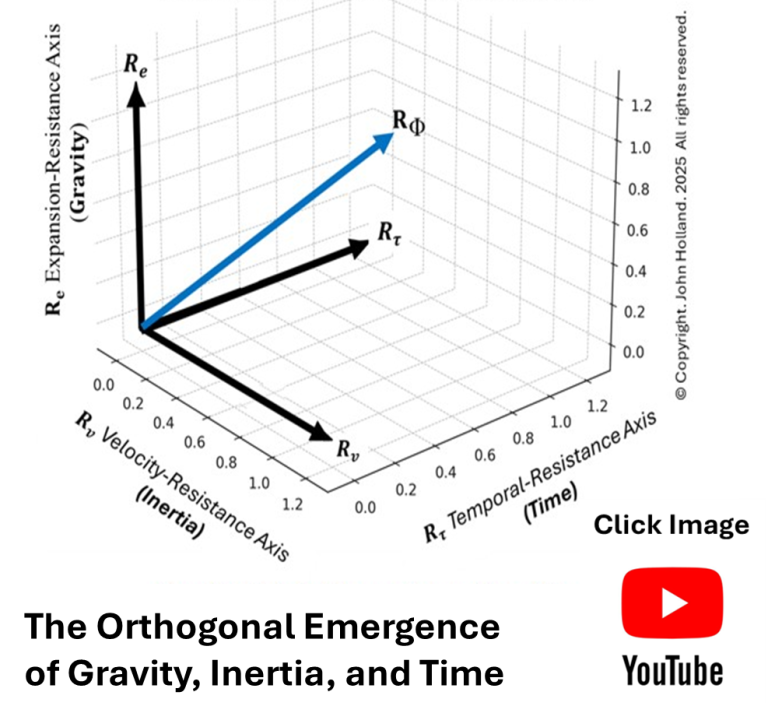
is "Mass"
Mass: The composite term of three scalar field resistences
EWSB triggers the orthogonal emergence of gravity, inertia, and time. Gravity it the resistance to expansion, inertia is the resistance to motion through the scalar field, time is temporal separation resistance... so... where does this leave all "mass"?
The Holland Atom Development Series
GETT supplies an all-pervading singlet scalar field that acts with density dependence... here we apply GETT to the atom, with a unified standing-wave resonance ontology which can reconstruct a broad range of experimentally established atomic phenomena, and appears to predict the periodic table...
Paper
I.
The Holland Atom Theory
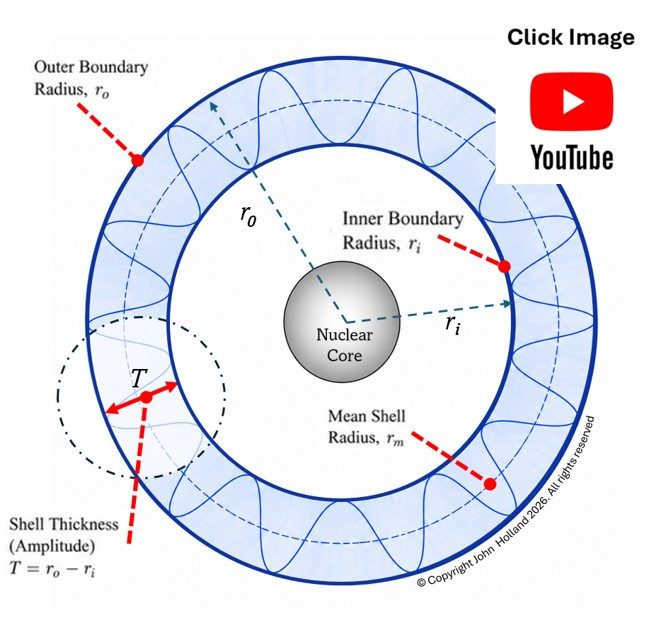
The reconstruction programme successfully reproduced shell-capacity structure, angular resonance-family structure, shell-opening order, sequential shell filling, radius contraction behaviour, lanthanide and actinide compression, and historically anomalous transition-metal configurations.
Paper
II.
Atomic Radius Variation and Shell-Band Geometry
The analysis reveals that radius variation behaves as a genuine physical observable rather than random measurement uncertainty. Atomic radius variation could be a genuine signal of shell-band width: a finite shell envelope in alignment with resonance-lock standing mode amplitude.

GETT:
A Unified Resolution Across Fundamental Problems in Physics
General Expanse Tension Theory (GETT) is proposed as a physically grounded framework in which a single underlying scalar field and its interaction with mass provide a unifying causal mechanism across multiple unresolved domains of physics. The following outlines how GETT offers coherent resolutions aligned with the major outstanding problems. Do you recall the 12 issues in the Problem Statement on the HomePage?
1. Classical–Quantum Unification
Within GETT, both classical and quantum behaviours emerge from the same underlying scalar field dynamics. In regimes of smooth, slowly varying density, the field supports continuous, metric-like behaviour consistent with classical physics. At smaller scales or under rapid variation, discrete excitations and probabilistic outcomes arise naturally from local field interactions. The divide between classical and quantum descriptions is therefore not fundamental, but a domain-dependent manifestation of a single substrate.
2. The Missing Causal Mechanism of Gravity
GETT provides a direct physical mechanism for gravity as the restoring effect arising from tension gradients in the scalar field. Mass resists expansion, creating local imbalances in the field’s flow. The resulting gradients drive a net movement toward equilibrium, experienced as gravitational attraction. This reframes gravity not as a geometric abstraction or action-at-a-distance force, but as a real, field-mediated physical process. Newton was correct within his domain limit with descriptive calculus, and Einstein was correct within his domain limit with descriptive geometry, however, these are purely mathematical equations - GETT delivers the underlying physical real cause.
3. Quantum Gravity
Rather than attempting to quantise spacetime geometry, GETT posits that gravity itself emerges from scalar field dynamics. This removes the need to directly reconcile incompatible mathematical frameworks, replacing the problem with a deeper physical description from which both quantum and gravitational behaviours arise as limits. The stongest hint was from CERN in 2012, when it became known that a quantum mechanism – electroweak symmetry breaking of the Higgs section assigns matter with the property "Mass". Mass is therefore emergent, not fundamental, and therefore, so are the phenonmena proportional to mass... gravity, inertia, and proper time.
4. Dark Energy
GETT interprets cosmic acceleration not as a separate energy component, but as a natural consequence of low-density conditions within the scalar field. The universe is expanding containing the same total amount of matter: mass density falls! As baryonic density falls
below a critical threshold, the coupling between matter and the field weakens, allowing expansion to proceed with reduced resistance. This produces an effective acceleration without requiring an additional dark energy term.
5. Dark Matter
Rather than invoking unseen mass, GETT attributes anomalous galactic dynamics to density-dependent modulation of the scalar field. In low-density regions, the field’s response to baryonic matter is altered, enhancing effective gravitational behaviour. Mass couples strongly with the expanding scalar background field, forcing matter forces to hold together with greater strain energy. This reproduces
observed rotation curves and large-scale structure without requiring non-baryonic dark matter.
6. Hubble Tension
In GETT, the expansion rate is not a universal constant but a function of local and epoch-dependent density conditions. Variations in scalar field coupling across different environments lead to systematically different inferred expansion rates. This naturally accounts for discrepancies between early-universe and late-universe measurements.
7. Cosmology Crisis
The broader set of cosmological tensions – early galaxy formation, structure growth, and expansion inconsistencies – are unified within GETT as consequences of applying fixed-parameter models across regimes where coupling is in fact density-dependent. By allowing physical parameters to vary with environment, these tensions are resolved within a single consistent framework.
8. Quantum Interpretation (Copenhagen Interpretation and Measurement)
GETT replaces intrinsic indeterminism with a physically real scalar substrate that permeates all space. Measurement outcomes arise from interactions between systems and the surrounding field, which encodes global boundary conditions. This removes the need for observer-dependent collapse while retaining the statistical behaviour observed in quantum experiments. The scalar field supports and propagates waves. Particles remain particles. The outcome is the removal of "wave-particle duality", "particle superposition", and a transfer back to the deterministic universe, without probablistic uncertainty, just as Einstein wished.
9. Singularities
In GETT, singularities do not represent physical infinities but signal the breakdown of classical approximations. At ultra-high densities, the scalar field transitions regime, altering its coupling behaviour and preventing divergence. The inverse of Electroweak Symmetry Breaking (EWSB) and the emergence of gravity, inertia, and time, in these ultra-dense regions we propose "Symmetry Resoration, and the de-emergence of gravity, interia, and time: eliminating the need for singular states.
10. The Origin of Mass
Mass in GETT arises from interaction with the scalar field, extending the Higgs mechanism by embedding it within a broader, density-
dependent coupling structure. The observed variation and hierarchy of masses are not arbitrary constants, but emergent properties determined by environmental field conditions. EWSB triggers the orthogonal emergence of gravity, inertia, and proper time. Mass is a composite term of these three universe resistances.
11. The Origin of Inertia
Inertia is interpreted as resistance to changes in motion through the scalar field. It is the reconfiguration energy. As objects accelerate, they induce distortions or flows within the field, which react to restore equilibrium. This provides a direct physical mechanism for inertial resistance, grounded in field dynamics rather than assumed as intrinsic.
12. The Arrow of Time
Within GETT, the arrow of time arises naturally from the one-way evolution of the scalar field toward equilibrium under continuous expansion. As mass resists expansion, it creates persistent tension gradients that drive a net, irreversible flow of energy redistribution in the field. This ongoing relaxation process defines a preferred temporal direction: forward time corresponds to the progressive dissipation of these gradients toward equilibrium, while reverse evolution would require a spontaneous, global increase in ordered tension: physically disallowed.
Summary
Across all domains—from quantum behaviour to cosmological structure—GETT proposes that a single, continuous scalar field, coupled to matter in a density-dependent manner, provides the missing causal foundation underlying modern physics. Rather than introducing additional components or disconnected theories, it seeks to unify observed phenomena through a common physical mechanism whose behaviour varies systematically with environment and scale.
Unexplained Structure, Filaments, Nodes, Voids, and Hierarchy
The Cosmic Web
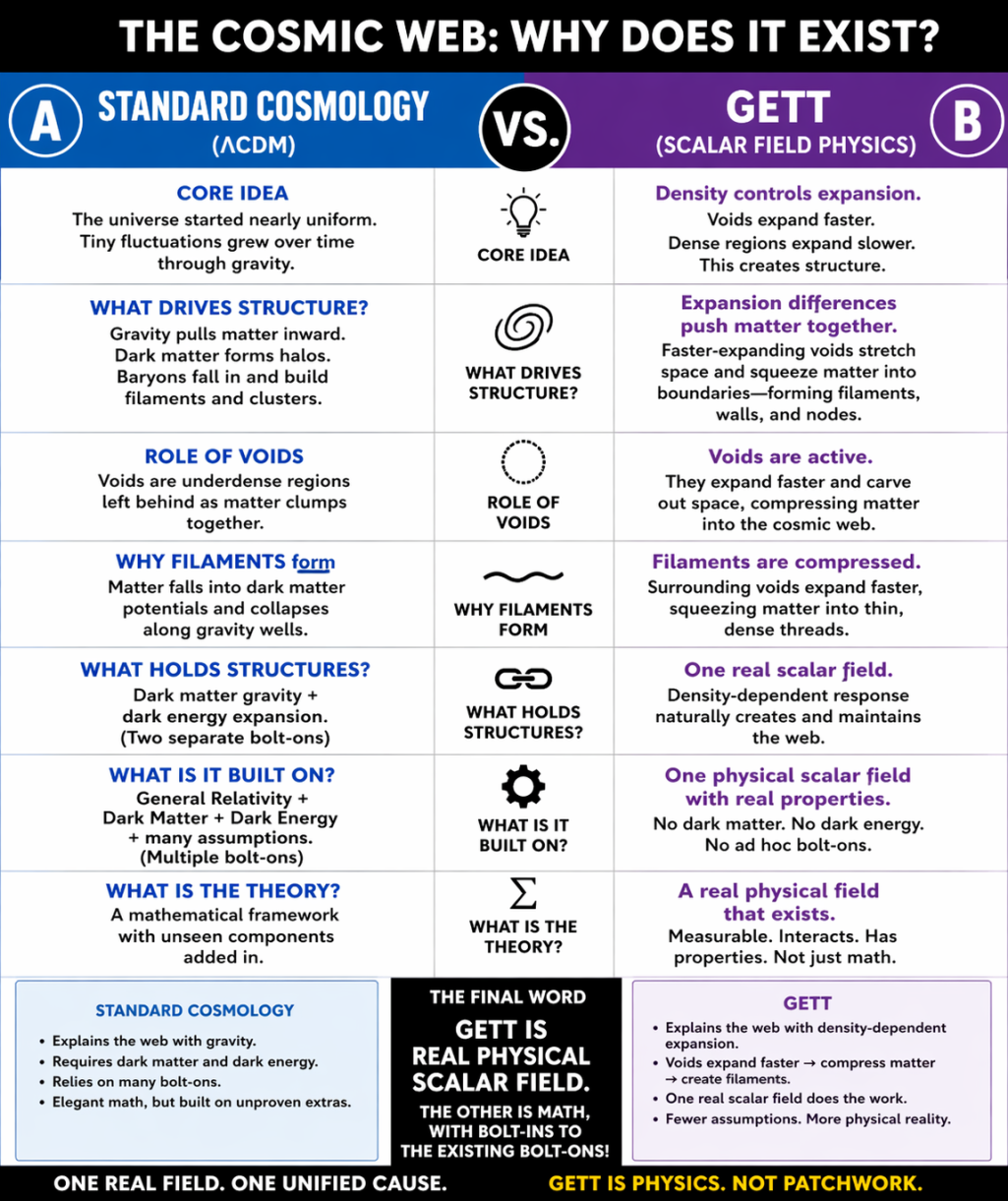
ΛCDM says matter collapsed into a web. GETT would say voids expanded the web into existence.

Wigner’s Friend Re-Interpreted Through GETT
GETT demonstrates that quantum mechanics, while operationally
successful, remains ontologically incomplete.
Abstract
Wigner’s Friend is one of the most discussed thought experiments in quantum foundations. It was originally proposed to highlight
unresolved questions concerning measurement, observer status, and the meaning of the quantum state. In orthodox formulations, one observer inside a laboratory obtains a definite measurement result, while an external observer may still describe the entire laboratory as evolving in superposition. This has been taken to challenge the consistency of observer-independent facts.
This paper argues that the paradox arises not from nature itself, but from an incomplete ontology assigned to the quantum formalism. Within the framework of General Expanse Tension Theory (GETT), a real all-pervading scalar field Φ provides the deeper physical substrate through which measurement outcomes become definite via interaction dynamics. Wigner’s Friend is thereby reinterpreted as a
distinction between internal physical state formation and external informational incompleteness, rather than a contradiction in reality.
1. Introduction
Eugene Wigner introduced the Wigner’s Friend scenario in 1961 as an extension of the measurement problem in quantum mechanics.
A “friend” inside a sealed laboratory measures a quantum system and records a definite result. Meanwhile, an external observer, Wigner, may still assign a superposed quantum description to the laboratory as a whole.
The scenario raises several famous questions:
- When does measurement truly occur?
- Does consciousness play a privileged role?
- Can two observers assign incompatible realities?
- Is wavefunction collapse physical or epistemic?
- Are observer-independent facts preserved?
These questions remain central to debates around the Copenhagen interpretation, Many Worlds, QBism, relational approaches, and
hidden-variable models.
2. The GETT Ontological Framework
GETT proposes that beneath quantum phenomena lies a real, universal scalar field Φ (the Holland Field), physically present throughout spacetime. Matter, measurement devices, and observers are embedded within and interact through this substrate.
Within this framework:
- Quantum states are effective descriptions of accessible information and response amplitudes.
- Measurement is a real dynamical interaction between system, apparatus, environment, and Φ.
- Macroscopic outcomes arise when interaction thresholds produce stable state-selection.
- Later observers acquire information about an already-established physical state.
Thus, the ontology is physical first, informational second.
3. Re-Interpretation of Wigner’s Friend
3.1 What Happens Inside the Laboratory
When the Friend measures the particle, the following occurs:
- The particle couples to the detector.
- Detector amplification creates macroscopic differentiation.
- Environmental interactions rapidly decohere alternatives.
- The Φ-field response stabilises one realized outcome.
- The Friend records and experiences a definite result.
At this stage, the measurement event is complete physically.
No external observer is required to finalize reality.
3.2 What Wigner Describes Outside
Outside the laboratory, Wigner lacks access to the result. Therefore, he may assign a probabilistic or superposed state description to the unseen lab.
Under GETT, this description refers to Wigner’s uncertainty, not the laboratory’s unresolved ontology.
This distinction is decisive:
- Inside lab: definite physical state
- Outside lab: incomplete information state
There is no contradiction because epistemic state and ontic state are not identical.
4. Resolution of the Original Attack Angles
- A. Does consciousness cause collapse?
- No. Consciousness is not fundamental to measurement. A detector, recorder, or automated system would suffice. State-selection is caused by
physical interaction dynamics in Φ.
- B. Can two observers have different realities?
- No. They can have different information. Reality remains singular; knowledge may differ by location and timing.
- C. Is superposition macroscopic and literal?
- Only as an effective formal description prior to information access. GETT rejects literal coexistence of contradictory macroscopic facts.
- D. When does measurement occur?
- Measurement occurs when irreversible coupling and stable outcome registration are achieved. This is a physical threshold event, not a
psychological one.
- E. Are observer-independent facts lost?
- No. Facts exist once the event is physically registered, whether or not a later observer has learned them.
- F. Does the wavefunction represent reality?
- Not fully. It is an operational state-description with predictive power, but not a complete ontology.
5. Illustrative Replacement Scenario
Replace the Friend with:
- an automated detector
- a camera
- a metal stamp marking UP or DOWN
- environmental heat dissipation
If no human is present, does reality wait outside the door?
GETT answers no. The recorded result exists once physical interaction completes. Human awareness is merely delayed access to fact.
This exposes the true content of the paradox: confusion between knowledge acquisition and state creation.
6. Scientific Implications
The GETT reinterpretation suggests that foundational quantum paradoxes may arise when mathematical state vectors are mistaken for exhaustive physical reality.
A deeper field ontology allows:
- objective measurement outcomes
- consistent observer-independent facts
- removal of consciousness privilege
- reconciliation of quantum measurement with physical causation
- possible unification pathways linking quantum theory and gravity
7. Conclusion
Wigner’s Friend has enduring value because it exposes weaknesses in standard interpretational language. However, it need not imply
observer-created reality, contradictory facts, or metaphysical indeterminacy.
Within GETT, the paradox dissolves naturally. The Friend’s measurement completes through real system–apparatus–environment
interaction mediated within the scalar field Φ. Wigner’s later superposed description reflects temporary informational limitation, not
unfinished existence.
Accordingly, Wigner’s Friend is reclassified not as evidence against realism, but as evidence that quantum mechanics, while operationally successful, remains ontologically incomplete.
A physically grounded substrate restores a coherent distinction between reality and knowledge—and with it, the scientific intelligibility sought by Einstein and many others since.