Expanse Tension Theory
Library & Research
We are dedicated to developing pioneering scientific theories that directly addreess the the major anomalies, mysteries, paradoxes and anomalies of our Universe.
Our major theories, ETT & GETT, if validated through peer review, have the potential to
positively impact science, physics, cosmology, astrophysics, and the quantum realm in
profound ways. We engage with a community of dedicated scholars and passionate scientists to foster an environment of innovation.
Here, we catalogue major segment of physics through the lense of GETT. Please take a look at what a single all-pervading quantum density-modulated scalar field can achieve;
Section 1.
Theory Core Foundations
All gravitational, inertial, and cosmological phenomena arise from density-dependent coupling between mass and universal expansion, mediated by a single scalar field (Φ), unified with Higgs mass licensing. This includes the following principles:
- Gravity emerges from density-dependent tension gradients in a unified Holland–Higgs scalar field Φ, with spacetime curvature interpreted as a geometric projection of field stress-energy.
- Gravity is emergent and suppressed except in low-density regimes where Φ becomes ultralight; it is not a fundamental interaction.
- Gravitational waves as emergent field perturbations (ETRs)
LIGO/Virgo signals reinterpreted as Φ tension waves
Observational equivalence demonstrated. - Inertia arises from resistance to changes in Φ–expansion coupling; gravity and inertia share a common field origin but manifest orthogonally.
- Gravitational and inertial mass equivalence emerges from shared Φ coupling. Not postulated; derived from the same scalar dynamics
Use the links to the resources below and video on the right hand side to learn more.
Section 2.
General Relativity
Modified gravity theories often fail Solar System and binary pulsar tests.
Also there is no underlying explanation as to WHY mass-energy equivalence holds.
ETT Shows automatic self-screening (hybrid chameleon/symmetron behaviour) ensuring exact GR recovery for ρ ≫ ρ_c.
Use the links to the resources below and video on the right hand side to learn more.

Section 3
Galactic Dynamics (dark matter, comets and red supergiant)
Scale of outer shells and evidence of inner shells is not explained. GETT density thresholds trigger frozen shells and void dynamics.
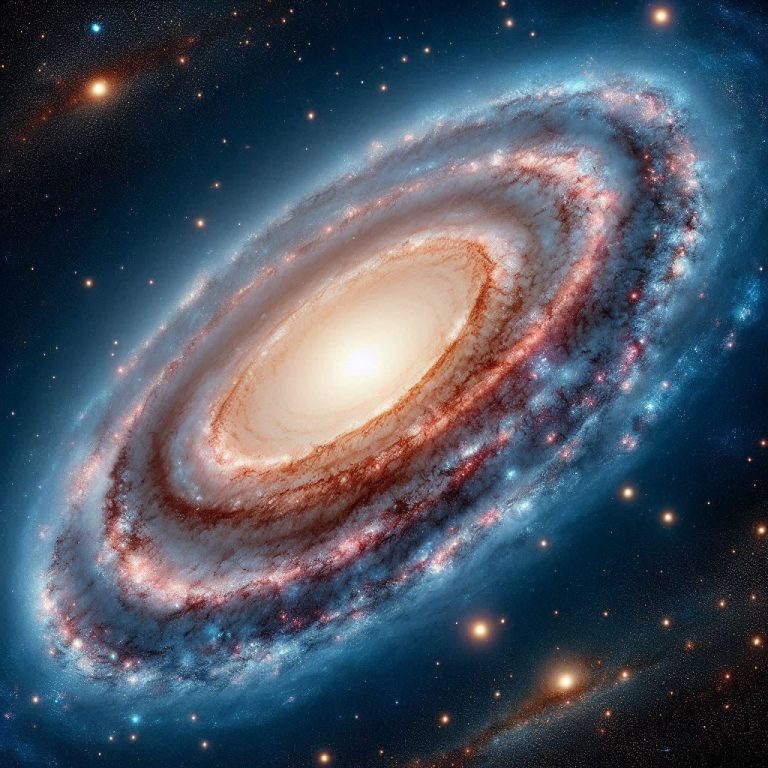
Observed flat rotation curves in the outer regions of galaxies require unseen dark matter in ΛCDM. ETT predicts a critical density threshold (ρ_c ≈ 10⁻²¹ kg m⁻³) where Φ transitions from Higgs mode to Holland mode, producing flat rotation curves without dark matter.
Polarity reversal in Φ halts gas collapse. Matches observed star-formation thresholds.
Use the links to the resources below and video on the right hand side to learn more.
Section 4
Early Universe
Massive structure formation millions of years before time to evolve has elapsed. There are 59 distinct and unique mysteries, paradoxes, unexplained events and anomalies which undermine the current explanations of the early universe (listed in the paper).
1. Applied the orthogonal emergence of gravity, inertia, and time from electroweak symmetry breaking (EWSB).
2. Prior to EWSB, gravity, inertia, and proper time have not emerged.
3. After EWSB, apply temporal separation resistance (time dilation), to slow time and permit the natural evolution of the early universe.
Use the links to the resources below and video on the right hand side to learn more.
Section 5
The Atomic and Subatomic World
There is evidence that:
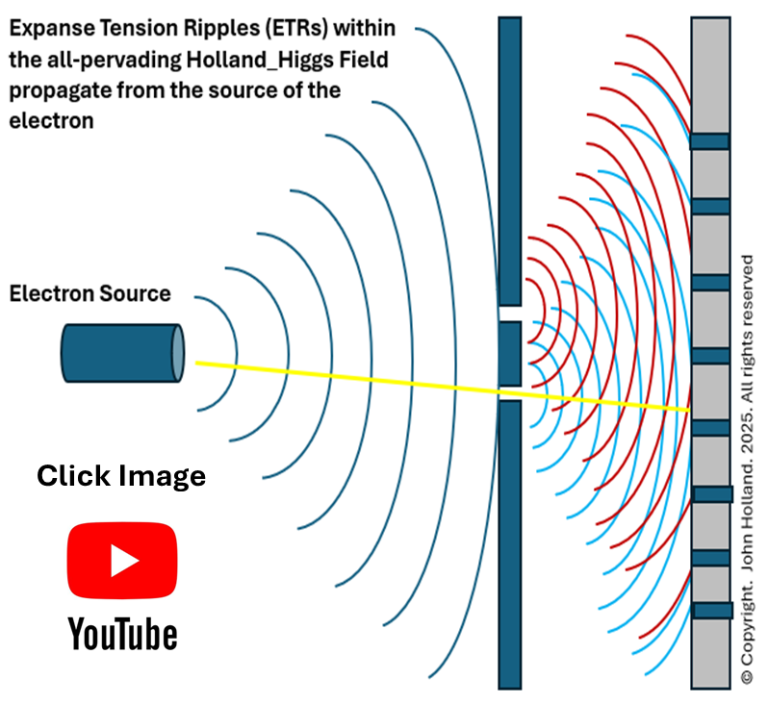
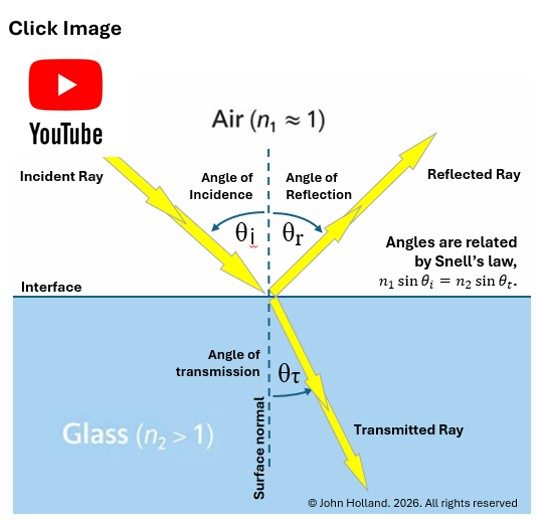
- light shone through 2 slits produces interference pattern.
- particles (electrons, neutrons etc) fired one at a time at 2 slits still produce an interference pattern.
The Holland-Higgs field progapates and supports the pressure wavefront of the particle, preceding the particle. Passes both slits, whilst the particle only ever passes 1 slit.
Even with a single particle fired, one at a time, the interference pattern in the Holland-Higgs fieldlow gradient regions influence the path of the particle.
Use the links to the resources below and video on the right hand side to learn more.

Section 6.
Cosmic dynamics – the Hubble tension, late time acceleration (dark energy)
Use the links to the resources below and video on the right hand side to learn more.
Join the Journey
Contribute to Scientific Evolution
Become a part of our mission to redefine the boundaries of scientific understanding.
Stay informed on our latest research, collaborate with us in ongoing projects, and contribute to the vibrant dialogue surrounding the Expanse Tension Theory.