The GETT Correspondence Series of Domain-Limited Reconstruction of Physics (GCS-DLRP).
For any new theory to be taken seriously, it must faithfully reproduce everything we already know works, within the conditions where those results have been proven valid.
This section will also hold key tests and criteria, beginning with Bell Theorem, see below.
Standing on the Shoulders of Giants...
Introduction
0.
The GETT Correspondence Series
A structured programme reconstructing established physics as domain-limited reductions of a deeper scalar-field framework, reproducing validated laws while predicting controlled deviations. Access the formal published report, or click each image on the right to access the summary video explanation.
Paper
1.
Classical Kinematics
Within the weak-field regime — the laboratory and solar-system
environment where classical mechanics of inertial motion,
acceleration laws, orbital mechanics, and energy relationshas been tested for centuries — the analysis shows that the GETT framework
reproduces the entire Newton–Kepler kinematic structure exactly.
Paper
2.
Newtonian Dymanics and Kepler's Planetary Motion
The GETT scalar-field equation reduces to the classical Poisson equation for the gravitational potential, and the resulting
acceleration law becomes identical to the Newtonian inverse-square relation and the entire structure of classical gravitational mechanics follows directly.

Einstein's Relativistic Universe
Paper
3.
Special Relativity
The first attempt to reconstruct the full structure of Special Relativity as a domain-limited physical correspondence layer. How Lorentz transformations emerge from physical conditions, not
assumptions. Reviews why time dilation, length contraction, and
relativistic energy follow naturally with GETT.

Paper
4.1.
General Relativity I.
Emergent Metric Structure "Spacetime".
The GR metric structure that governs clocks, rods, signal propagation, and free motion is fully recovered – not as a fundamental description, but as an emergent, domain-limited representation of underlying field dynamics using GETT scalar field framework within the limited mid-density regime. Spacetime is emergent from deeper physical substrate.
Paper
4.2.
General Relativity II.
Einstein Dynamics and Field Equations
This work presents, to the best of the author’s knowledge, the first scalar-field-based correspondence derivation of General Relativity, in which both the dynamical structure and Einstein field equations emerge as a controlled, leading-order limit of a deeper physical system - the GETT density dependent quantum scalar field.
Paper
4.3.
General Relativity III.
Classical tests in the GR domain
Here we show that once the Einstein-domain is established, the standard tested consequences are recovered by the GETT scalar field framework, including gravitational redshift, gravitational time dilation, light bending, Shapiro delay, perihelion precession, and weak-field lensing
Paper
4.4.
General Relativity IV.
Beyond the Einstein Domain
By systematically identifying where General Relativity succeeds and fails, GETT shows that gravity is a density-regulated interaction rather than universally constant. It defines the Einstein-domain plateau and explains deviations as threshold-driven behaviour from scalar–matter coupling, unifying phenomena across
cosmological, galactic, and compact-object regimes.

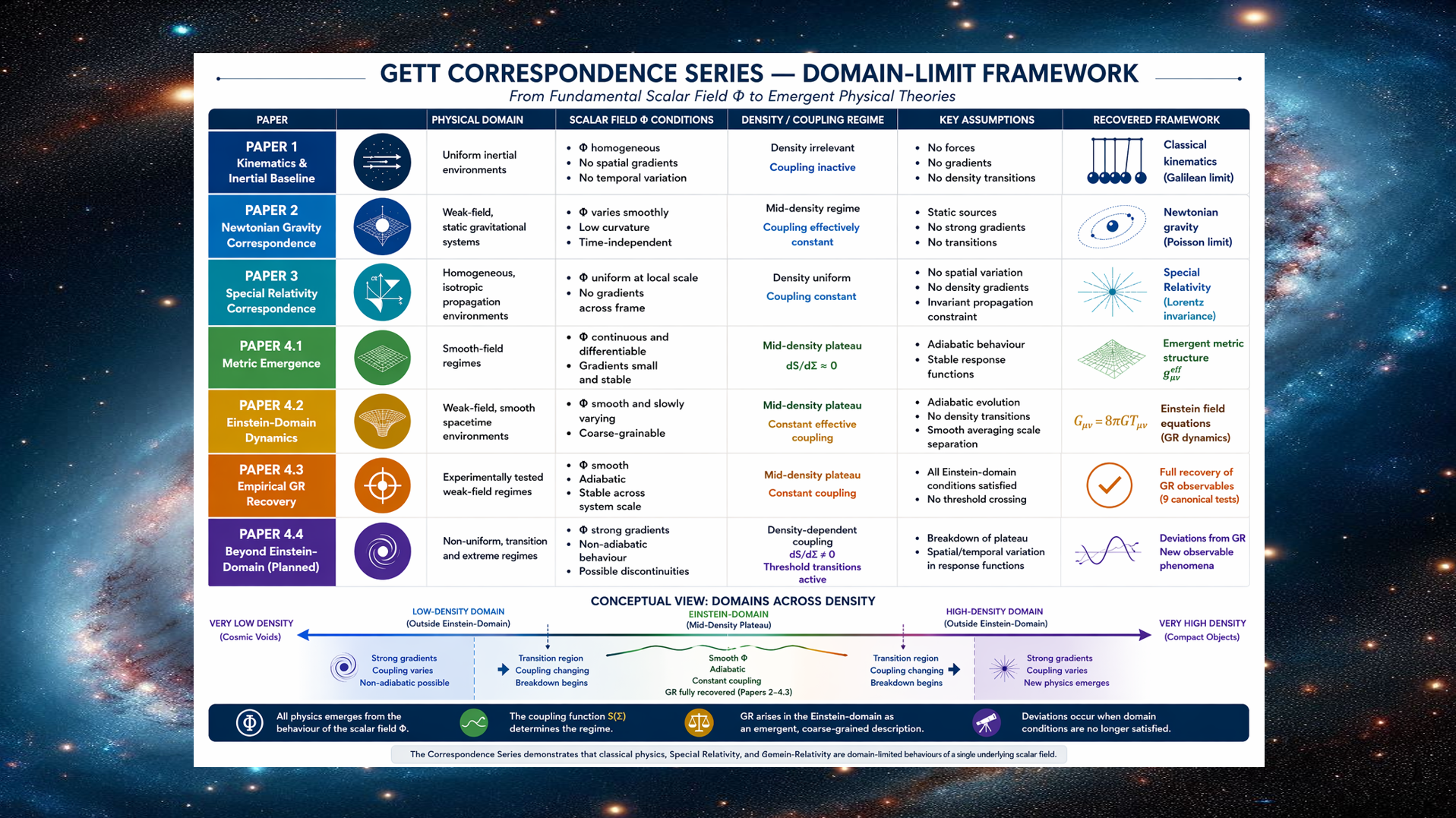
Newton gave us force. Einstein gave us geometry. GETT gives us the real physical field that makes both emerge.
General Relativity is the mathematical description of the GETT physical reality
We used to say ‘spacetime tells matter how to move’. GETT says;
‘the scalar field tells measurement devices how to respond — and the result looks like spacetime curvature’
Geometry is not fundamental. It is the emergent, coarse-grained bookkeeping of how clocks, rods and signals respond to the local state of a single real scalar field.
Photon Lensing & Energy Laws
Paper
5.
Photon Lensing Across Regimes: Mass, Voids, and Density-Conditioned Deflection
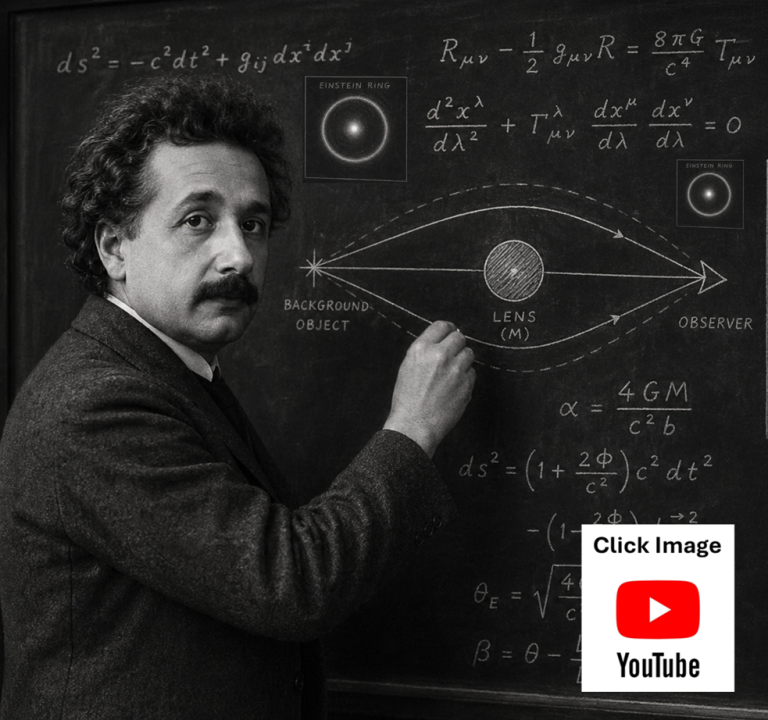
The correspondence of gravitational lensing within the Einstein-Domain, leading to a unified density-regulated framework for photon lensing across overdense and underdense regimes, linking gravitational and propagation behaviour through a single scalar-field mechanism
Paper
6.
Quantum Mechanics Pre-Copenhagen Interpretation
From 1900 to around 1920 ever more prescise experiments resulted in empirical observation which could no longer be reconciled with classical physics. The outcome was the most radical departure from realism to an indeterminate universe of only probablistic randomness. Would the presence of GETT have changed the direction of physics over the last hundred years since?

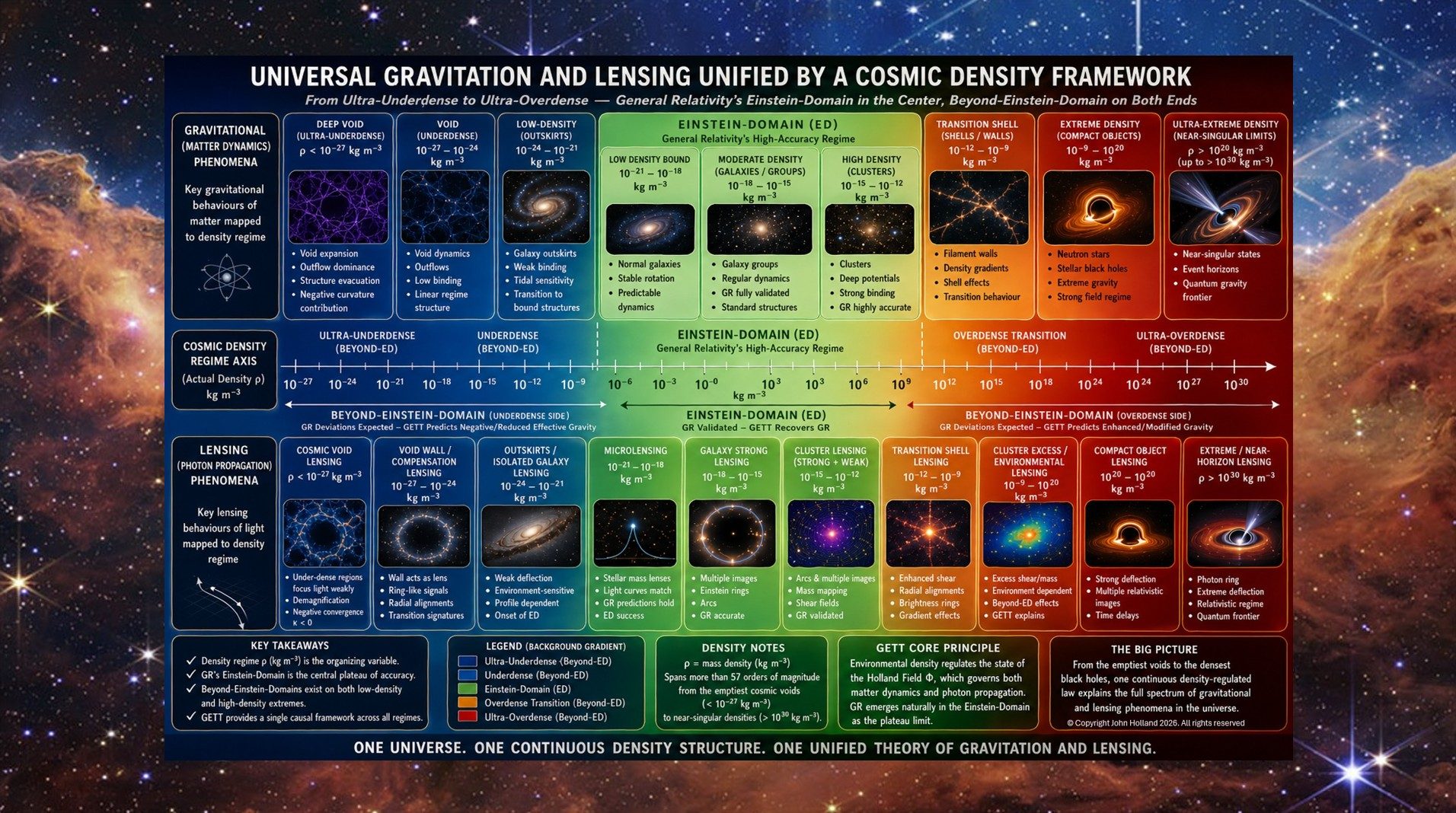
A unified density-regulated framework for photon lensing across overdense and underdense regimes, linking gravitational and propagation behaviour through a single scalar-field mechanism.
Gravitation and Lensing Correlate
If you take the Papers 4.1 to 4.3 (Einstein-Domain), Paper 4.4 (Beyond the Einstein-Domain) and Paper 5 (Photon Lensing) and throw them together and plot the results against a single common universal mass density scale, something mircalous, and nontrivial appears. By "non-trivial" we mean "unexpeced", "not necessary according to current science". Density emerges as a universal common factor.
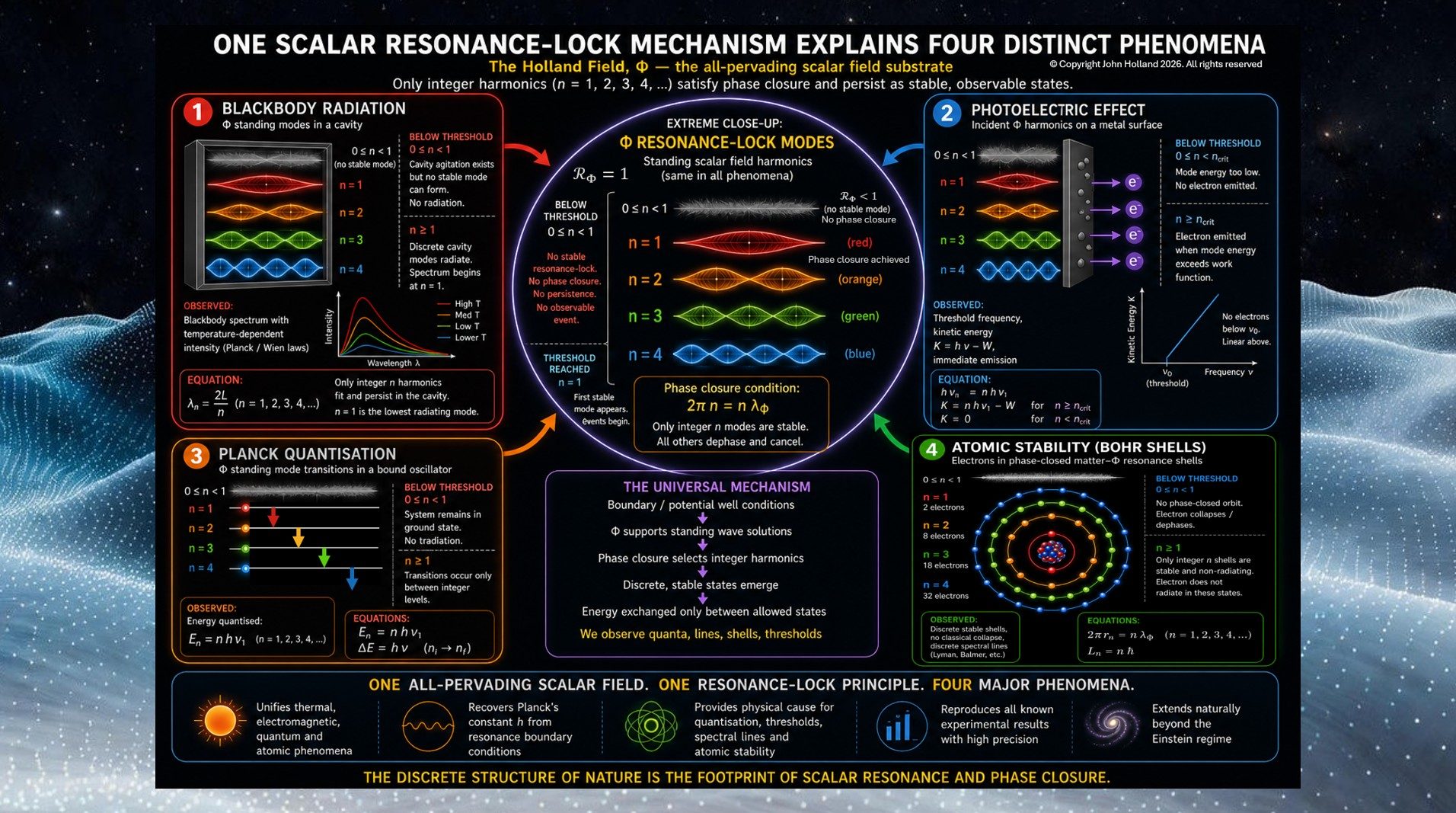
What if the Copenhagen interpretation of the 1920's was just a lttle too hasty?...
GETT Recovers 1920's Quantum Mechanics Prior to the Copenhagen Interpretation
By the 1920's classical physics was in crisis as the evidence of blackbody radiation, Planck quantisation, the photoelectric effect, atomic
stability, discrete spectral structure, and wave–particle duality with double-slit interference all conflicting with continuous energy.
Did the original quantum evidence uniquely require the abandonment of physical realism… or might the same observations have admitted an alternative causal interpretation had a physically admissible substrate been available? What if the observed discrete packages of
energy, radiation, and apparent wave-particle behaviour is like looking at torque delivered through a scalar field resonance-lock gear box?
The empirical evidence that originally motivated quantum mechanics does not, by itself, uniquely require Copenhagen ontology.
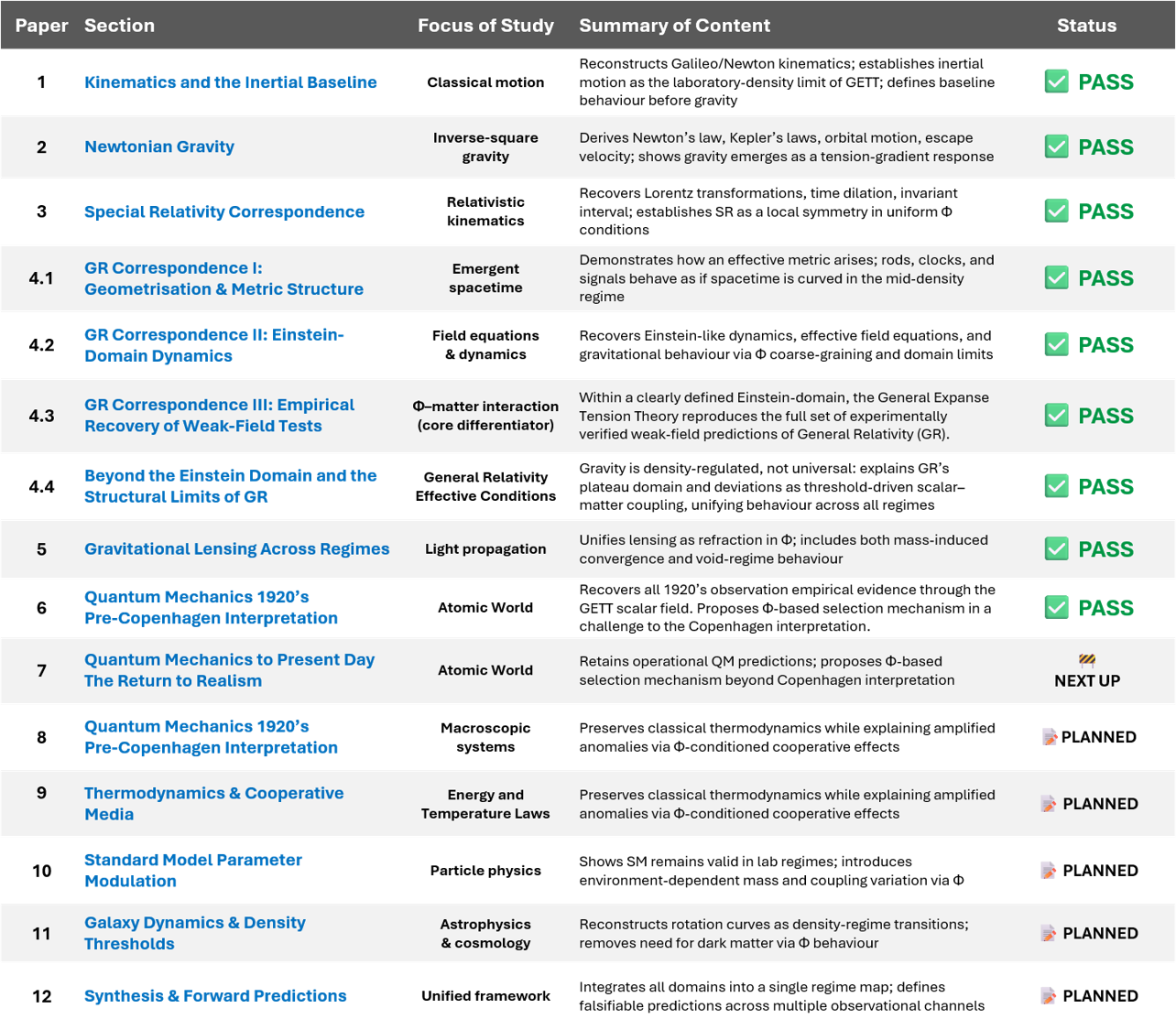
How is the GCS-DLRP programme progressing to date?
GETT Correspondence Series Scorecard
The programme has achieved a 100% pass across all completed stages, successfully reconstructing classical mechanics, Newtonian gravity, and relativity. The combined achievements of Papers 4.1 and 4.2 represent a stunning, unprecedented milestone in reproducing gravitational structure and dynamics from a deeper framework.
Behind us.
For GETT to pass both Special Relativity and General Relativity is a significant milestone. GR becomes domain-limited. Then for Gravitation and Lensing to fit together in to a single framework covering both the Einstein-Domain and Beyond!
Work ahead
There remains much work to compete, with the next stage to study the well established Laws of Energy Conservation and thermodynamics, then Quantum Mechanics - a world of unintuitive weirdness - can GETT unpick and resolve?
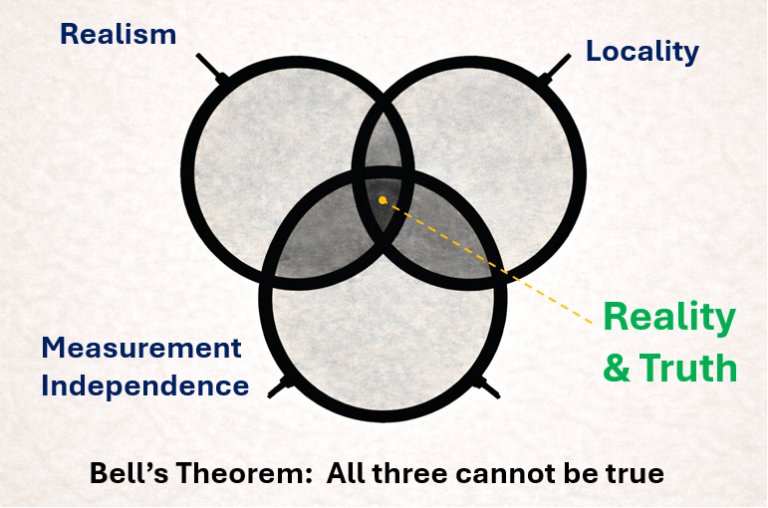
Bell's Theorem
The world cannot behave in a way that is fully classical, fully local, and fully independent of how we choose to measure it — all at the same time.
Bell's Theorem
One of the three assumptions of reality must be wrong.
Realism
Physical properties exist with definite values before we measure them.
Things have real properties whether we look at them or not.
Locality
No influence can travel faster than the speed of light.
Events here cannot instantly affect events far away.
Nothing happening here can instantly affect something far away.
Measurement Independence
The choices of what we measure are independent of the underlying state of the system. In other words, the experimenter is free to choose settings, and those choices are not pre-correlated with the system.
We can freely choose what to measure, and that choice isn’t secretly pre-arranged with the system.
Bell's Theorem
No theory of nature can simultaneously satisfy a small set of very reasonable assumptions about how reality works — and still
reproduce the results we observe in quantum experiments.
Over decades, increasingly precise experiments have tested Bell’s inequalities. Key results include: Photon entanglement experiments, Loophole-free Bell tests, Long-distance quantum correlation measurements. These experiments consistently show that nature violates Bell’s inequalities. This means the central overlap — where all three assumptions hold — is not realised in nature. At least one of the three must give way.
Within the GETT framework, the interpretation naturally shifts.
GETT maintains:
- Realism — physical processes are grounded in a real, all-pervading scalar field
- A structured notion of locality — interactions propagate through a real substrate with finite dynamics
However:
- The scalar field is continuous, connected, and universal
- It permeates both the system being measured and the measurement apparatus
This has an important implication: Measurement settings and system states are not strictly independent — they are embedded within the same underlying field structure.
So in GETT measurement independence is relaxed and
correlations arise through the shared scalar field background. This provides a route to reproduce observed quantum
correlations without abandoning realism, and without requiring abstract, observer-dependent interpretations.